St. Albert Transit Vehicles | Infrastructure: Transit Centres, Bus Stops, Garages | Ride Guides and Schedules | Fare Media | Promo Material/ Ads/ Events | Former Buses
Basic History
St. Albert Transit provides transit service to the City of St. Albert, located Northwest of Edmonton, as well as commuter service to Edmonton.
It formerly operated a commuter service to Morinville.
Service started on April 1, 1974 with ETS operating 3 regular ETS buses to St.
Albert at peak times. This evolved with St. Albert purchasing a fleet of 10 GM
T6H-5307N buses in 1976. These buses were still storage, garaged, maintained,
and operated by Edmonton Transit. With the larger fleet, service to the
University of Alberta as added. Local service was
provided
Briggs Bus Lines with
schoolbuses.
1986 was a big year for St. Albert Transit. St. Albert built a new garage in
town and took over
took over operations from Edmonton Transit on July 2, 1986. Grey Goose
was contracted to provide drivers for the buses, with PW Transit later winning
the contract which later passed on to Keolis following the sale of PWT to
Student Transport of America and their later divestiture of some of the business
units to Keolis.
Through the following years, MCI Classic's would be added to grow the fleet. New
Flyer D60's arrived in 1991 making St. Albert Transit the first system in
Western Canada to place these buses into service. St. Albert Transit also staked
claim to having the first regularly scheduled low floor bus in Canada, thanks to the
purchase of 888, later renumbered 843, a 1992 New Flyer D40LF demonstrator built
to BC Transit specs with 3 additional 3 D40LF's arriving in 1993, which I believe
I read were
part of a consortium order with Edmonton Transit and Calgary Transit. School
buses on local routes ceased being used in 1995, and low floor buses gradually replaced the high
floor buses through the late 2000's into early the 2010's. During 2003/04 there
was a brief flirtation with smaller size buses with the purchase of 4 30' Thomas
SLF-230 buses, before returning to New Flyer in 2005 for 40' buses. 2006 brought a batch of
D60LF's which were interestingly powered by the Cat C9 engine. While a common
enough option to see on New Flyer articulated bus orders around this time,
the only other Canadian property to use this engine was an order for Hamilton of
DE60LFR's.
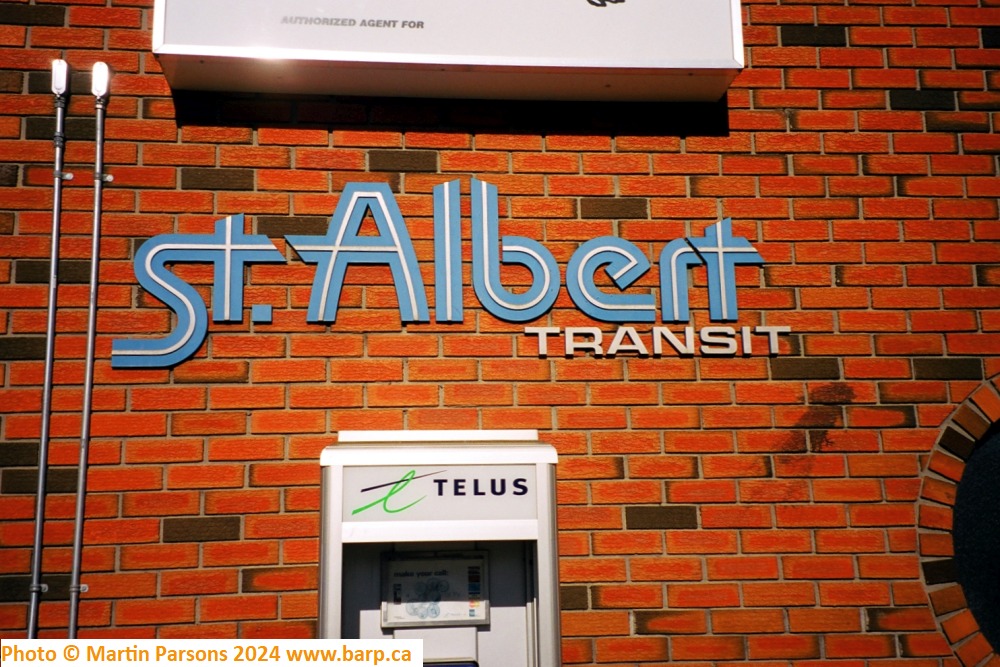
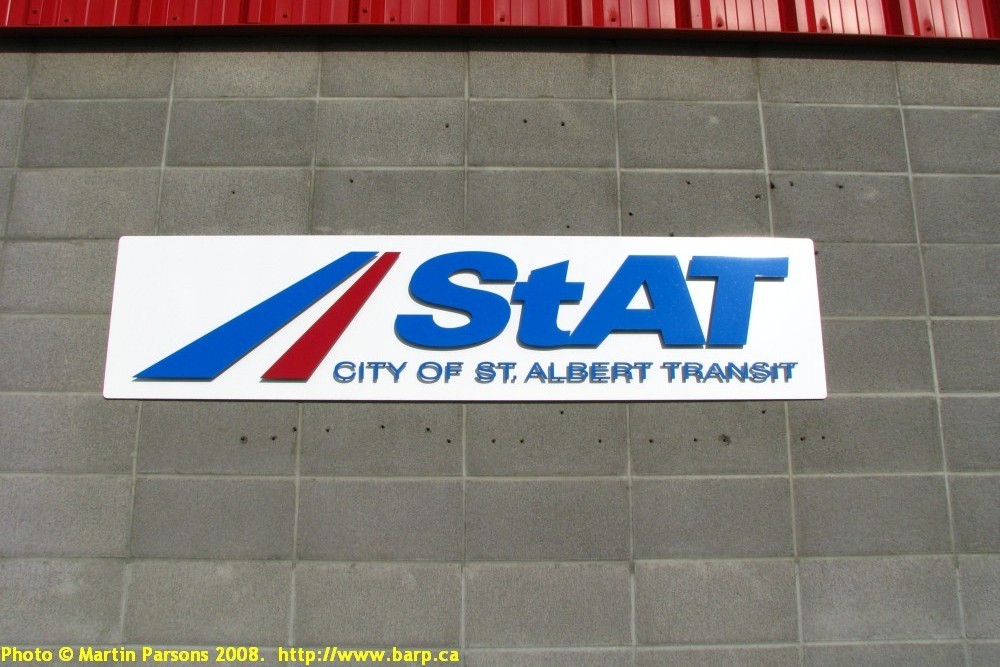
Going back to the 1980s the logo was a stylized "St. Albert" with "Transit" below it. This logo was replaced in 2004 with the abbreviation "StAT", while retaining the existing blue and red colours. 2014 saw a new logo and paint scheme introduced, intended to compliment the City of St. Albert's new Botanical Arts City imagining. While new buses were delivered in the new colours, only 881 was repainted into them after a major collision. All buses received the new logos. St. Albert transit introduce electric buses with 3 BYD K9S35 in 2017, with 3 more arriving in 2018.
Route Numbering and Destination Signs
St. Albert Transit retains a legacy route numbering scheme that started with ETS
in 1962, using a letter prefix to identify where the bus route ran in the city.
These included:
B- Beverly
D- Downtown (only the D1)
J- Jasper Place
N- North side
R- Ring route
S- South side
U- University
While Edmonton Transit would abandon this concept in 1976, with St. Albert
service starting in 1974 their routes received the prefix "A".
St. Albert continues to use the "A" prefix for local routes to this day,
although a significant change was made coinciding with the opening of the St.
Albert Centre Exchange in July 2000 when the commuter routes were moved into the
200's.
Along with adopting the ETS route numbering scheme, St. Albert also adopted the
3 piece roller sign on the GM New Look buses. Although St. Albert's signs were
just white text on black, unlike ETS's which also used yellow and red
backgrounds, they still featured the route number in the middle position. The
left position (when looking at the bus) was typically used for displaying either
"Edmonton" or "St. Albert" while the right position was the routes destination.
Much like the letter prefix, Edmonton Transit abandoned this style of sign in
1976, the same year St. Albert adopted it! Strathcona County Transit would also
adopt this style of sign, who used it well into the 2000's. Additionally, it was
also used by Calgary and Red Deer.
The 3 pieces
signs would be replaced over time with 2 piece signs simply consisting of a sign
for the route number, and sign for the destination, and the first Classic's and
D60's were delivered like this. Starting with the 1992 Classic's, 1993 D40LF's,
and 1995 D60's larger 2 piece signs were utilized, and this carried on up to,
and including, the 2001 D60LF's.
The one exception to these was the 1992 D40LF #843. Being built to BC Transit
specs, it came with a flip dot electronic destination sign. This was St. Albert
Transit one and only flip dot sign. It wasn't until the arrival of the 2004
Thomas SLF's that the amber LED destination sign became standard for St. Albert
Transit. Roll signs would continue to be utilized largely until buses were
retired, although a number of 1999 D40LF's were upgrade to LED signs late in
their life as the instances of roll signs dwindled in the fleet.
St. Albert Transit Vehicles |
Infrastructure: Transit Centres, Bus Stops, Garages |
Ride Guides and Schedules
|
Fare Media
| Promo Material/ Ads/ Events | Former
Buses